If Ten People on Your Team Agree, Nine of Them Are Unnecessary
/I was working with a leadership team. Seasoned group. Company doing well. Everyone moving forward seemingly in unison except for one executive. The CEO wasn't sure how to manage it.
That leader caused friction. They didn't fit. The rest of the team was aligned. Only one kept pushing back.
I looked at the BestWork data before I said anything.
That leader was certainly an outlier. That part the CEO was right about. In every cluster, they sat at the opposite end from the rest of the team. Detail-oriented versus not. Structured versus always looking for a better way. The team was all the way right across almost every dimension. The outlier was all the way left.
I asked the CEO one question.
"What if that leader isn't the problem?"
What the Data Showed
I use the BestWork Data instrument because it maps our strengths. Behavioral, psychometric, and cognitive. Insight into how people naturally think and process information. It also lets you see an entire leadership team on one chart in addition to evaluating people one at a time.
This team was a cluster. (No, not that kind of cluster.)
All but one of them stacked at the same end of almost every dimension. Detail-oriented. Structured. Rule-following. And then the outlier, all the way on the other side.
What looked like difficult behavior had a different explanation. One was wired to look for a different way. To challenge the process. To ask why before moving forward. To innovate.
We still had to separate performance questions from the compatibility questions. Data didn't excuse missed outcomes. It showed us that the difference wasn't, by itself, evidence of any failure to deliver.
In a company where the rest of the team lived by the rules and the structure and the process, one was asking uncomfortable questions.
A CEO doesn't always know how to make it work when one isn't like all the others.
They need to see that it is also a strength.
Leaders Don't Fire Outliers Because They're Ineffective
Leaders often dismiss or fire outliers because they make everyone uncomfortable.
That is different from measuring effectiveness.
Performance and friction are not the same metric. A person can challenge assumptions, slow consensus, push back on decisions, and still be exactly what a team needs. The discomfort they create is often the point.
“If there are ten people in the room and they all agree, nine of them are unnecessary.”
I say this to clients often. Most nod. Then they go back to surrounding themselves with people who think the way they do.
It's not malicious. It's human. We hire people we can assess. We read someone like us far better than someone who isn't. If you're highly urgent and you need someone patient, you don't trust your ability to spot patience in an interview. You trust your ability to spot urgency.
So we build teams in our own image without meaning to.
The team chart makes that visible. It doesn't show individual strengths in isolation. It shows the shape of the team. Where everyone clusters. Where there's overlap. Where there's a gap no one has named.
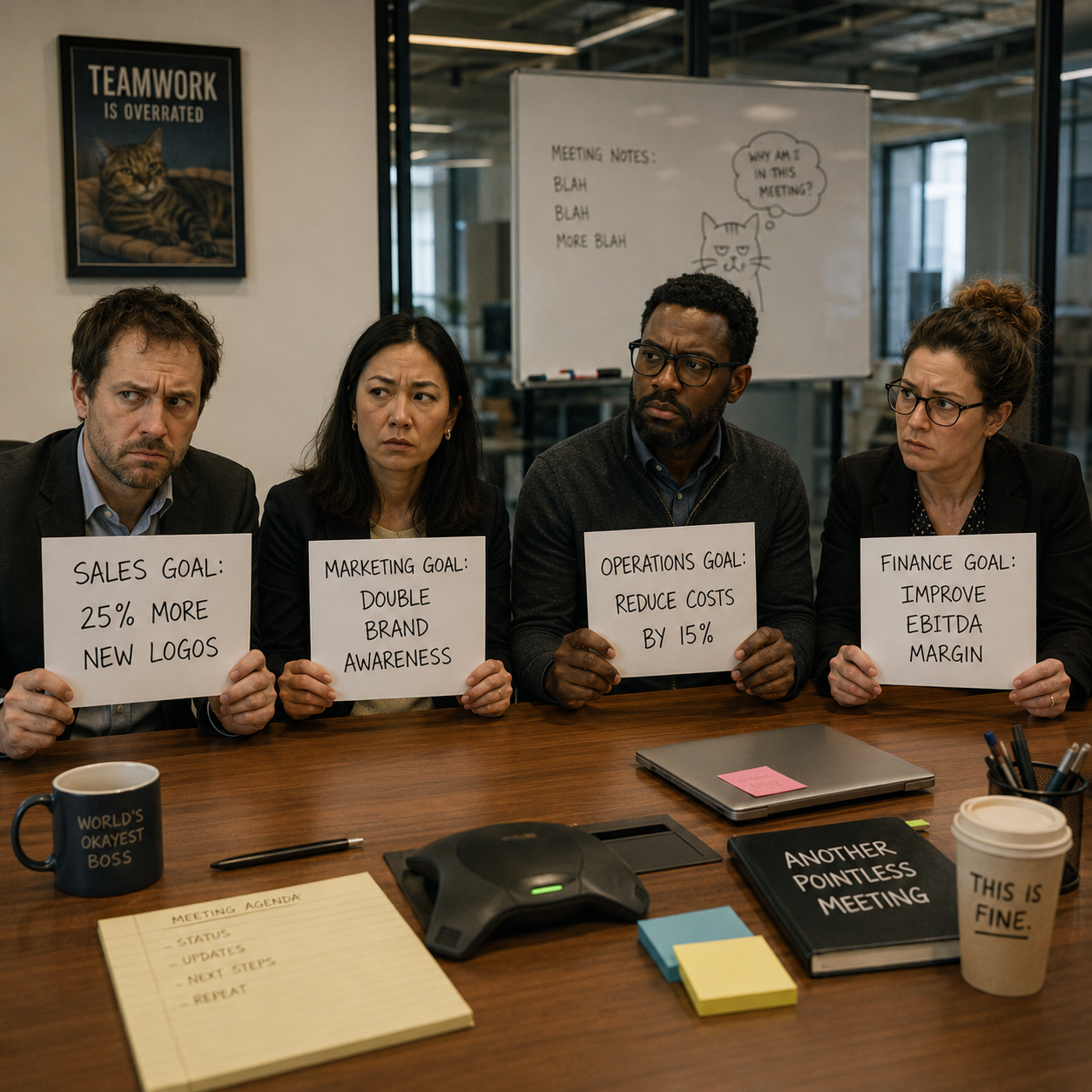
A healthy team looks like a spectrum. What most leadership teams look like is a cluster. Everyone in the same corner. Sometimes with the one outlier standing alone on the other side.
The outlier is often the person protecting the team from its own blind spots.
The Question That Changed How I See This
Years before I started using BestWork Data, I had my own version of this problem.
His name was Hayward. He made every room more complicated. He had opinions on everything, pushed back on decisions that seemed settled, and rarely let a meeting end without some version of dissent.
I was frustrated. I brought it to my executive coach.
She didn't tell me how to manage him. She gave me an exercise instead.
Imagine your organization without him. Walk through it. Who does what he does? What happens to the work he carries? What does the room look like when he's not in it?
I sat with it.
The answer surprised me. Hayward was the one who saw around corners. He asked the question nobody else was asking. He was the visionary in a room full of operators, and without him, we would have moved faster and worse.
I didn't have BestWork Data back then. I had a coach who forced me to look at the organization differently. The insight was the same: the person creating the most friction may also be filling a gap nobody else can.
The data gets you there faster. The destination is the same.
It's Not the Dimension. It's the Distance.
When I look at two profiles side by side, I'm not looking at which dimensions differ.
I'm looking at how far apart they are.
Two people can both score toward the urgent end of the spectrum and still work well together. Two people at opposite extremes, both deeply rooted, both convinced they're being reasonable, will find each other almost unbearable.
I've seen this in other companies. In one case, two senior leaders, both experienced, both committed, at completely opposite ends of the spectrum. Every conversation escalated. Every decision became a standoff. They tried to work through it. They brought in a therapist. Not a coach. A marital therapist. (Mind you, they were colleagues, not family.)
When I think back to their profiles, the distance was extreme. Not in one dimension. In several. Each of them was wired in a direction the other couldn't easily reach, let alone accommodate. Both felt constantly misunderstood. Neither was wrong.
In both cases, the structure failed to account for the distance between them.
They didn't need better communication skills. They needed a third person. Someone in the middle, someone who could translate from one end of the spectrum to the other.
When I came in, I was that person. Not by design. By profile.
The friction eventually resolved. Not because they changed. Because the structure changed.
The data didn't fix the relationship. It explained why the relationship was so hard. And explaining why something is hard is often enough to stop making it mean something else.
The Outlier Wasn't the Problem
That seeming out-of-alignment leader isn’t the problem with the team. The outlier was the insurance policy against everyone else thinking the same way.
The instinct was to build a team that moved in the same direction, at the same pace, with the same set of perspectives. Consistency is created at the expense of range.
The goal isn't alignment of strengths. It's coverage.
The most dangerous teams I've seen weren't the ones with conflict. They were the ones with none. Where every conversation ends in agreement. Where nothing gets surfaced. Where the people who see things differently may have learned to stop saying so.
That's not a smooth-running team. That's a team with blind spots that nobody names.
That outlier was the one naming it.
Leaders may still find them hard to work with. They probably always will.
That's not the question.
The question is this: if they leave, who asks the question nobody else in the room is wired to ask?